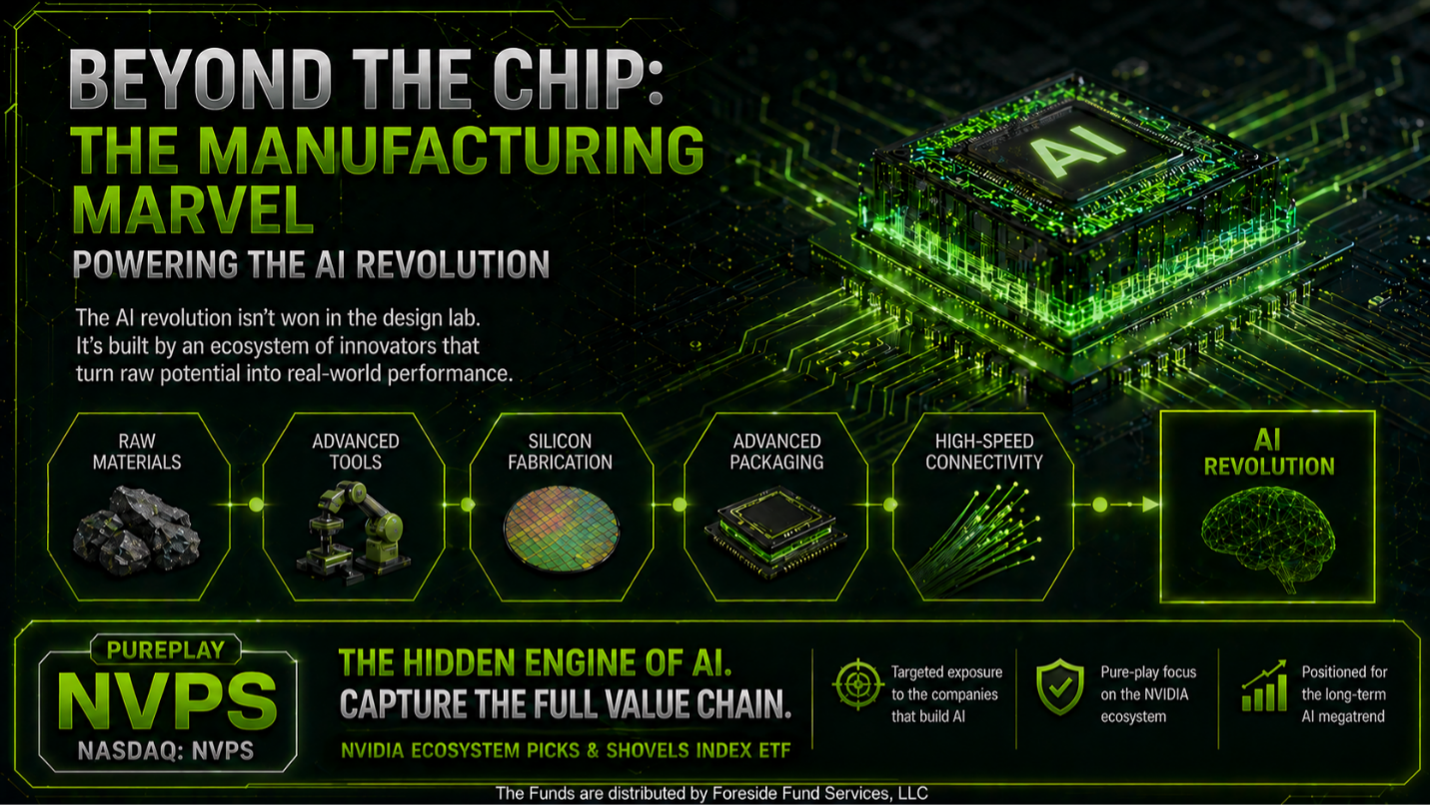
Everyone recognizes the leading semiconductor companies driving the artificial intelligence narrative. However, designing a cutting-edge AI chip is only half the battle. Actually building it requires orchestrating the most complex manufacturing process in human history.
For financial advisors constructing precision AI portfolios, we believe that focusing solely on the companies that design the chips misses a massive segment of the value chain. The true economic moat often lies upstream, with the companies that manufacture the tools, fabricate the silicon, and package the final product.
To capture this hidden side of the industry, we launched the PurePlay Nvidia Ecosystem Picks & Shovels Index ETF (NASDAQ: NVPS). NVPS is designed to provide targeted exposure to the raw materials, advanced tools, fabrication, and connectivity companies that physically build the AI ecosystem.
[Explore the NVPS Prospectus and Current Holdings Here]
The Complexity of Modern Tools
Silicon fabrication no longer operates like standard industrial manufacturing; it operates at the extreme limits of physics. Modern foundries must print billions of microscopic transistors onto a single silicon wafer. To achieve this, semiconductor manufacturers rely on an exclusive network of highly specialized equipment providers.
This includes extreme ultraviolet (EUV) lithography systems—machines that cost hundreds of millions of dollars and require multiple 747s to transport. It also includes complex chemical vapor deposition machines, metrology inspection systems, and atomic-level etching tools. Because the barrier to entry in semiconductor equipment manufacturing is almost impossibly high, these tool providers remain an essential, irreplaceable bottleneck in the global AI supply chain.
The Shift to Advanced Packaging and Connectivity
Furthermore, the traditional method of shrinking transistors to increase computing power is running into the laws of physics. In response, the industry is shifting toward "advanced packaging." Instead of relying on one massive piece of silicon, manufacturers are now connecting multiple smaller chips (called chiplets) and high-bandwidth memory (HBM) modules together into a single, highly efficient package.
Once these chips are packaged, they must be linked together in massive clusters inside the data center. Training AI models requires thousands of processors to communicate instantly, driving enormous demand for high-speed networking, optical transceivers, and advanced connectivity hardware.
Targeting the Value Chain with NVPS The artificial intelligence boom is not just a software phenomenon; it is a global manufacturing marvel. The foundries producing the wafers, the toolmakers building the lithography machines, and the connectivity providers linking the servers together represent the foundational layer of the AI ecosystem.
Broad technology ETFs often dilute this specific thesis by holding heavy weightings in consumer software, social media, or traditional tech generalists.
NVPS is built differently. It offers advisors a precision tool designed to target the critical fabricators, equipment manufacturers, and infrastructure providers powering the AI value chain.



Investors should consider the investment objectives, risks, charges and expenses carefully before investing. For a prospectus or summary prospectus with this and other information about the Fund, please visit the website at www.pureplayetfs.com. Read the prospectus or summary prospectus carefully before investing.
The Fund is distributed by Foreside Fund Services, LLC. Exchange Traded Concepts, LLC serves as the investment advisor of the Fund. Foreside Fund Services, LLC is not affiliated with Exchange Traded Concepts, LLC or any of its affiliates.
Risk Disclosures:
Investing involves risk, including possible loss of principal. There is no guarantee the Fund will achieve their stated objectives.
New/Smaller Fund Risk. A new or smaller fund is subject to the risk that its performance may not represent how the fund is expected to or may perform in the long term. In addition, new funds have limited operating histories for investors to evaluate and new and smaller funds may not attract sufficient assets to achieve investment and trading efficiencies.
Non-Diversification Risk. The Fund is non-diversified under the 1940 Act, meaning that, as compared to a diversified fund, it can invest a greater percentage of its assets in securities issued by or representing a small number of issuers. As a result, the performance of these issuers can have a substantial impact on the Fund’s performance.
NVIDIA Dependence Risk. Because the Index is designed to provide exposure to companies that have a material commercial relationship with NVIDIA, the Index, and therefore the Fund, is highly sensitive to NVIDIA-specific developments. Actual or perceived adverse events at NVIDIA, including financial distress, demand declines, supply or regulatory disruptions, litigation, reputational harm, strategic shifts, or insolvency, could impair the results and valuations of Index constituents that rely on NVIDIA as a key customer, supplier, or technology partner, leading to material declines and heightened volatility in the Fund.