The recent volatility across AI stocks has raised questions about the sustainability of the industry's growth and the enormous capital being committed to it. The PurePlay NVIDIA Ecosystem Picks & Shovels Index ETF (NASDAQ: NVPS) focuses on the companies supporting the broader NVIDIA ecosystem, offering a different perspective on an AI investment landscape increasingly dominated by debates over valuations, financing, and future returns.
[Explore the NVPS Prospectus and Current Holdings Here]
Why AI Stocks Are Under Pressure
The latest selloff reflects a shift in what investors are demanding from the AI trade. Strong revenue growth and ambitious spending plans are no longer enough on their own. Investors increasingly want evidence that the hundreds of billions being invested in AI infrastructure will generate attractive returns.
Three factors are driving the uncertainty.
The cost of the AI buildout. Major technology companies are committing unprecedented amounts of capital to data centers and computing capacity. As those investments grow, investors are scrutinizing how quickly they will translate into revenue and profits. Meta's recent plans to increase spending and raise additional capital have reinforced concerns about the cost of the buildout and how it will be financed.
Financing and interest rates. Not every company building AI infrastructure has the balance sheet of a major technology platform. Debt-dependent data-center operators face greater pressure when borrowing costs rise or investors become less willing to finance expansion. Recent concerns around heavily leveraged infrastructure providers have contributed to volatility across the broader AI sector.
Valuations and expectations. Many AI-related stocks have already priced in substantial future growth. Even when businesses continue performing well, their shares can decline if investors question whether the pace of growth will meet expectations. This is particularly relevant when valuations depend on profits that may not materialize for several years.
These concerns are legitimate. The scale of AI investment creates financial risks, and not every company will earn an attractive return on the capital it commits. But a repricing of expectations is not necessarily evidence that the underlying technology has reached its limits.
The Spending Behind the Headlines
Despite market volatility, the amount of capital flowing into AI infrastructure remains substantial.
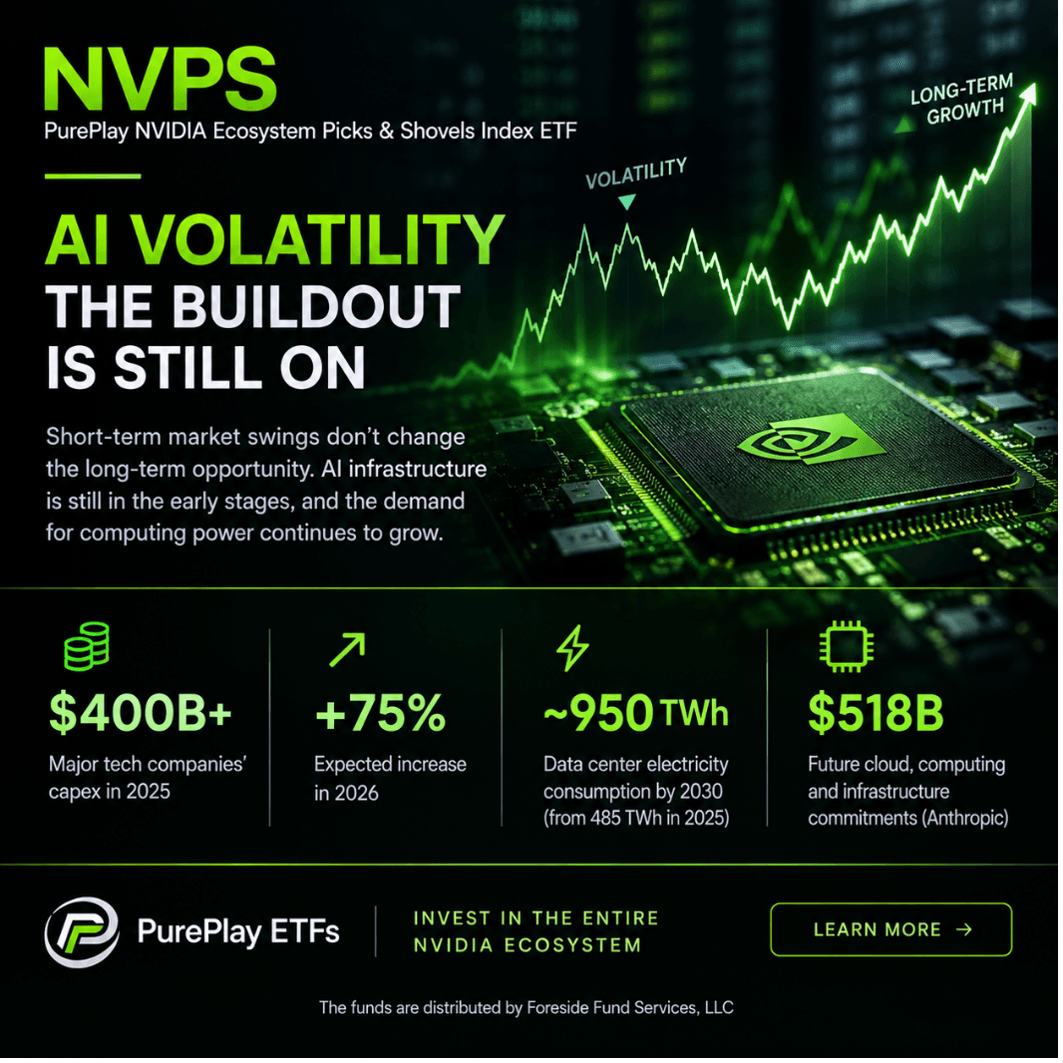
According to the International Energy Agency, capital expenditure by five major technology companies exceeded $400 billion in 2025 and is expected to increase by another 75% in 2026.1
J.P. Morgan Global Research estimated in October 2026 that global AI-related capital expenditure could reach approximately $900 billion this year, with cumulative spending projected to reach $5.5 trillion by 2030.2
These are forecasts rather than guaranteed outcomes. Some planned projects will be delayed or canceled, and the pace of investment will depend on demand, financing conditions, and the returns companies ultimately achieve.
Nevertheless, the scale of these projections highlights an important point: the AI industry is still committing enormous resources to expanding its computing capacity.
The demand outlook extends beyond spending budgets. The IEA projects that data-center electricity consumption will rise from approximately 485 terawatt-hours in 2025 to 950 terawatt-hours by 2030, while electricity consumption from AI-focused data centers is expected to triple over that period.3
The infrastructure required to support AI is becoming a major industrial investment cycle in its own right.
Why We Remain Bullish on AI
Our view is that the recent volatility should be evaluated separately from the longer-term opportunity.
AI is still developing rapidly, and its applications continue to expand across software development, enterprise workflows, research, automation, and other areas of the economy. As businesses find new ways to integrate these systems into their operations, demand for computing capacity could continue to grow.
At the same time, the industry is still working through the economics of deployment. Companies must determine which applications customers will pay for, how quickly adoption will scale, and how to deliver increasingly capable models efficiently.
That uncertainty is real. We do not assume that every dollar invested in AI infrastructure will generate an attractive return, or that every company associated with AI will be a winner.
But we believe the combination of expanding applications, continued technological progress, and substantial planned infrastructure investment supports a compelling long-term case for the industry.
The important distinction is between questioning the valuation of an individual stock and questioning whether AI will continue to develop as a major technology platform. Those are not the same thing.
Looking Beyond the Most Visible AI Stocks
The current market environment also highlights why the broader AI ecosystem deserves attention.
Investors often focus on a handful of highly visible companies, but the AI investment cycle affects businesses across the global NVIDIA supply chain. NVPS is designed to provide exposure to this broader ecosystem through six areas: Raw Materials, Tools, Fabrication, Packaging, Infrastructure, and Connectivity.
The fund's approach focuses on companies with material commercial relationships within the NVIDIA ecosystem rather than investing directly in NVIDIA itself.
As the AI industry develops, the balance of opportunity across these areas will evolve. Different companies will face different competitive pressures, and their stock prices will remain sensitive to valuations, spending cycles, and industry expectations.
For investors evaluating the recent volatility, we believe it is worth looking beyond daily price movements and considering the longer-term infrastructure investment taking place across the industry.
AI remains a developing technology with significant uncertainty, but the scale of investment and the potential for continued adoption make it an area we believe deserves close attention.
Sources
Key Questions on Energy and AI — IEA Executive Summary
What unprecedented AI capex means for markets and investors — J.P. Morgan Global Research
Key Questions on Energy and AI — IEA Executive Summary



Investors should consider the investment objectives, risks, charges and expenses carefully before investing. For a prospectus or summary prospectus with this and other information about the Fund, please visit the website at www.pureplayetfs.com. Read the prospectus or summary prospectus carefully before investing.
The Fund is distributed by Foreside Fund Services, LLC. Exchange Traded Concepts, LLC serves as the investment advisor of the Fund. Foreside Fund Services, LLC is not affiliated with Exchange Traded Concepts, LLC or any of its affiliates.
Risk Disclosures:
Investing involves risk, including possible loss of principal. There is no guarantee the Fund will achieve their stated objectives.
New/Smaller Fund Risk. A new or smaller fund is subject to the risk that its performance may not represent how the fund is expected to or may perform in the long term. In addition, new funds have limited operating histories for investors to evaluate and new and smaller funds may not attract sufficient assets to achieve investment and trading efficiencies.
Non-Diversification Risk. The Fund is non-diversified under the 1940 Act, meaning that, as compared to a diversified fund, it can invest a greater percentage of its assets in securities issued by or representing a small number of issuers. As a result, the performance of these issuers can have a substantial impact on the Fund’s performance.
NVIDIA Dependence Risk. Because the Index is designed to provide exposure to companies that have a material commercial relationship with NVIDIA, the Index, and therefore the Fund, is highly sensitive to NVIDIA-specific developments. Actual or perceived adverse events at NVIDIA, including financial distress, demand declines, supply or regulatory disruptions, litigation, reputational harm, strategic shifts, or insolvency, could impair the results and valuations of Index constituents that rely on NVIDIA as a key customer, supplier, or technology partner, leading to material declines and heightened volatility in the Fund.